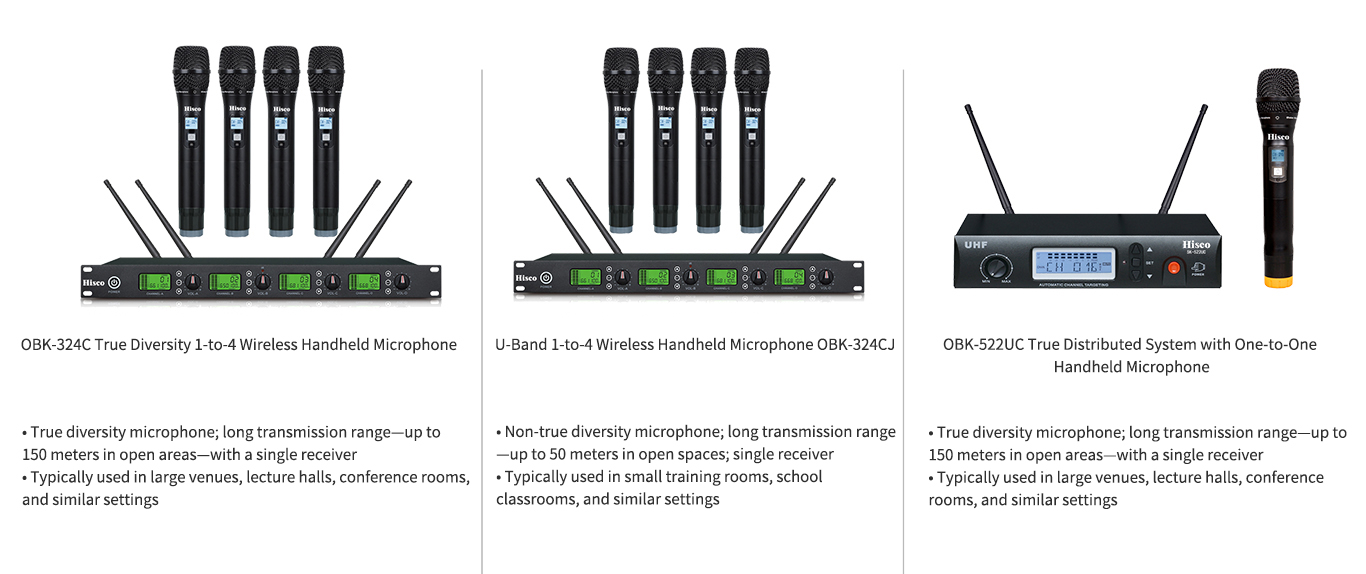



What is a U-band wireless microphone? It is a wireless microphone system that transmits audio signals using the 470–960 MHz ultra-high-frequency (UHF) band. It typically consists of a microphone and a receiver, with the microphone converting sound into radio waves and transmitting them to the receiver.
▶ Advantages of U-Band Wireless Microphones:
1. Strong interference resistance: Since cell phones, walkie-talkies, lighting consoles, and TV signals mostly operate outside the U-band, issues such as static, audio dropouts, and feedback are rare.
2. Multiple available channels with no frequency overlap among microphones: The U-band can be divided into hundreds of frequency points, allowing a single receiver to support 4, 8, or 16 microphones simultaneously, ensuring no interference during large-scale performances or speeches by multiple speakers;
3. Longer transmission range: Stable transmission over 30–150 meters in open areas, which is more than sufficient for indoor KTV venues and conference rooms;
4. More stable sound quality: With a wider dynamic range, it reproduces vocals clearly—high notes remain crisp and low notes remain full—making it ideal for singing and hosting.
▶ U-Band Wireless Microphones: True Diversity and Non-True Diversity
1. True diversity: One microphone, with simultaneous reception via two channels and two circuits.
Each microphone is equipped with two independent, complete receiving circuits (dual RF receivers, dual demodulators, and dual amplification channels) plus two independent antennas that simultaneously receive signals from the same microphone. One-to-two true diversity receiver: 4 antennas, with two independent receiving modules on each side; Microphone A uses the left dual channel, and Microphone B uses the right dual channel.
Advantages: Virtually no dead spots or blind spots; silent, seamless switching; greater resistance to interference; and a longer effective range
2. Non-true diversity: A single circuit for the entire unit, with two antennas that switch back and forth.
A single set of core receiver circuitry paired with two antennas, featuring only simple antenna switching and no two independent demodulation channels, makes it highly prone to signal dead zones when on the move.
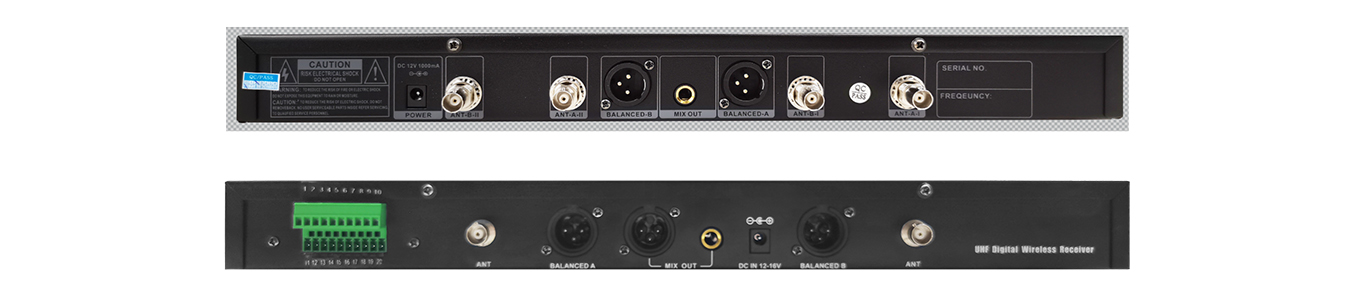
▶ U-Band Wireless Microphones—Use Cases:
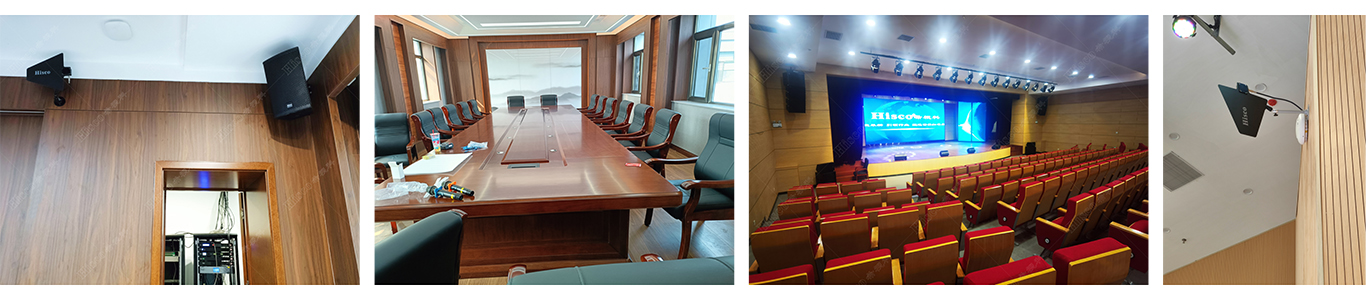
▶Multimedia: Professional Audio and Video—Wireless Microphones as Audio Sources
Simply put, a sound reinforcement system converts acoustic signals into electrical signals, which are then amplified, processed, and transmitted before being converted back into acoustic signals and reproduced in the intended sound field. A sound reinforcement system consists of the sound source pickup section, the mixing and control section, the audio processing section, the signal amplification section, and the loudspeaker section.
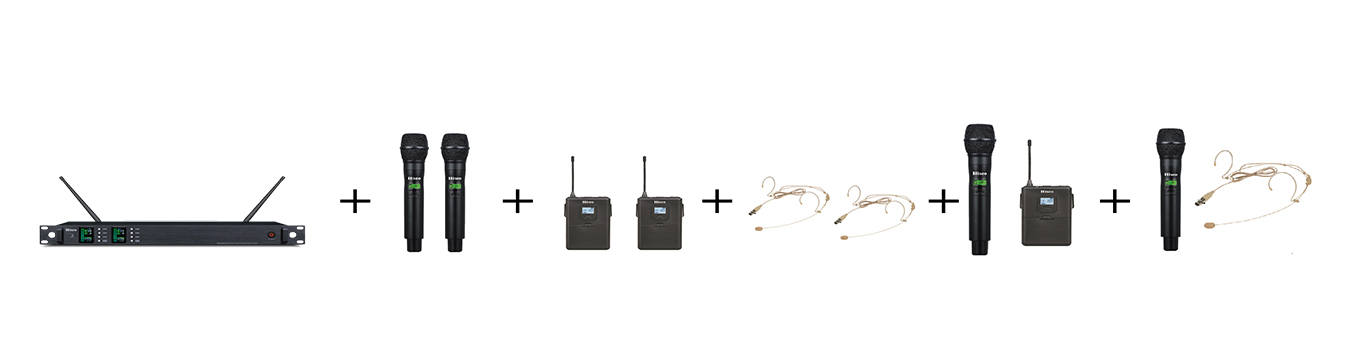
Our company offers a comprehensive range of audio products. For mobile speaking applications, we have the SK-524 series of handheld, headset, and lavalier microphones, which are suitable for professional theater performances; and the SK-525 series of handheld, headset, and lavalier microphones, which are suitable for hosts, pop and rock singers, and large-scale cultural and artistic performances. The SK-525 series microphones, featuring dual channels and four antennas, perform exceptionally well in venues requiring wide-range sound pickup and complex acoustic environments. We also offer handheld, headset, and lavalier microphones such as the SK-520 and SK-522 series, which are suitable for conference rooms and lecture halls. Our portable microphones are available in single-channel, dual-channel, and quad-channel configurations to meet your specific needs.
We also offer short- and long-stem gooseneck microphones, as well as one-to-two, one-to-four, and one-to-eight gooseneck microphone systems suitable for conference presentations.
These products meet the needs for capturing vocals, instruments, and audio playback. You can select the appropriate product based on your specific budget and functional requirements.
▶ Audio Equipment - AI Series U-Band Wireless Microphones (Superior Signal Stability)
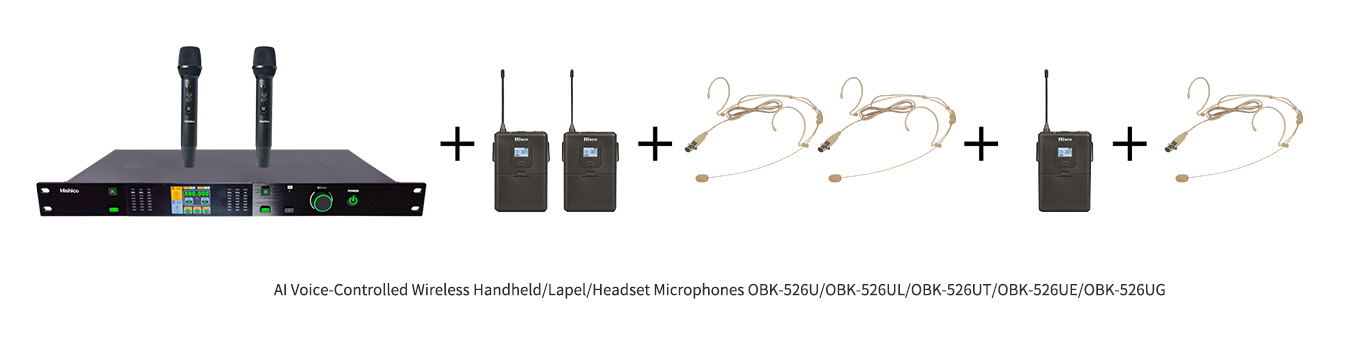
Integrated AI voice module that supports voice command control. After voice wake-up, it can control power, lighting, LED displays, video switching, volume adjustment, entrance signage, and scene switching, and provides voice feedback.
The microphone features built-in AI interface controls: 4 relay control interfaces, 2 RS-232 control interfaces, 1 line input, and 2 sets of voice feedback monitoring.
Real-time voice feedback: It broadcasts a response upon receiving a command; continuous interaction capability: After a single wake-up command, it supports continuous voice command control.
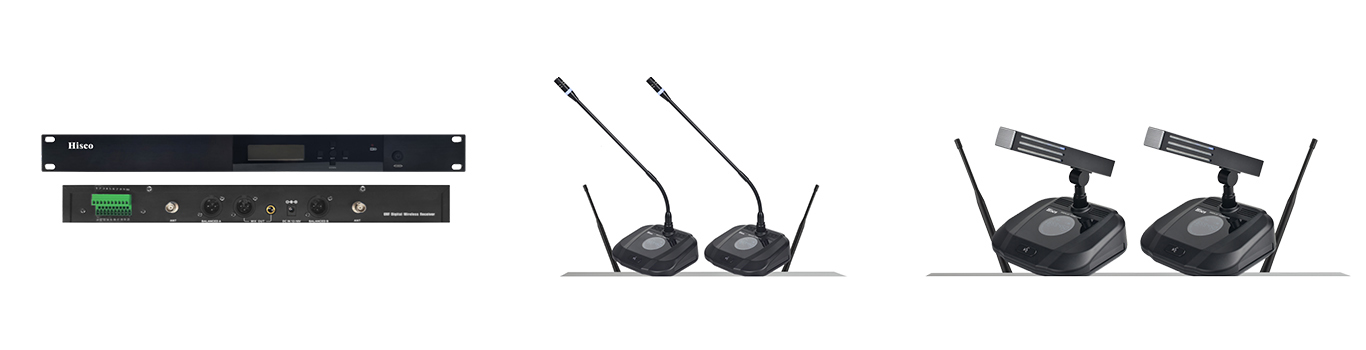
1.8-inch Screen:
1. Features a high-precision voice recognition module with an accuracy rate of ≥99.9%. It offers pure voice control and precise semantic understanding, and can be customized to recognize specific keywords for triggering.
2. Integrates an AI voice module that supports voice command control. After voice wake-up, it can control power, lighting, LED screens, video switching, volume adjustment, entrance signage, and scene switching, and provides voice feedback and reminders.
3. The device features built-in AI interface controls: 4 relay control interfaces, 2 RS-232 control interfaces, 1 line input, and 2 sets of voice feedback monitoring channels.
4. Real-time voice feedback: It responds with a voice message upon receiving a command; continuous interaction capability allows for continuous voice command control after a single wake-up.
▶ Microphone Equipment
OBK-520UH Handheld Wireless Microphone / OBK-520UL Wireless Lavalier Microphone / OBK-520US Wireless Headset / OBK-520UT (One Handheld, One Lavalier) / OBK-520UV (One Handheld, One Headset) / OBK-520UW (One Lavalier, One Headset)
1. Uses pi/4 DQPSK digital modulation technology
2. Non-true diversity microphone (one transmitter, two receivers); short transmission range—60 meters in open areas, single receiver
3. Typically used in small training rooms, school classrooms, and similar venues
4. Features an automatic clean channel search function
5. Frequency range: 640–690 MHz
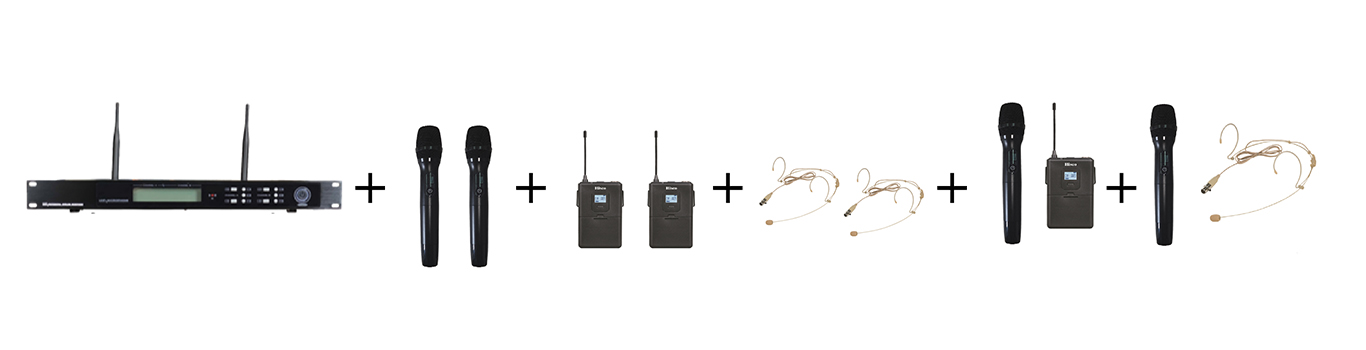
1. Operates in the UHF 520–930 MHz band to avoid interference frequencies.
2. Features a phase-locked loop (PLL) frequency synthesis stabilization system, providing 200 channels.
3. Frequency range: UHF 520–930 MHz
4. True diversity microphone (one transmitter, two receivers); short transmission range—150 meters in open areas, single-receiver configuration
5. Typically used in large venues, lecture halls, conference rooms, and similar settings
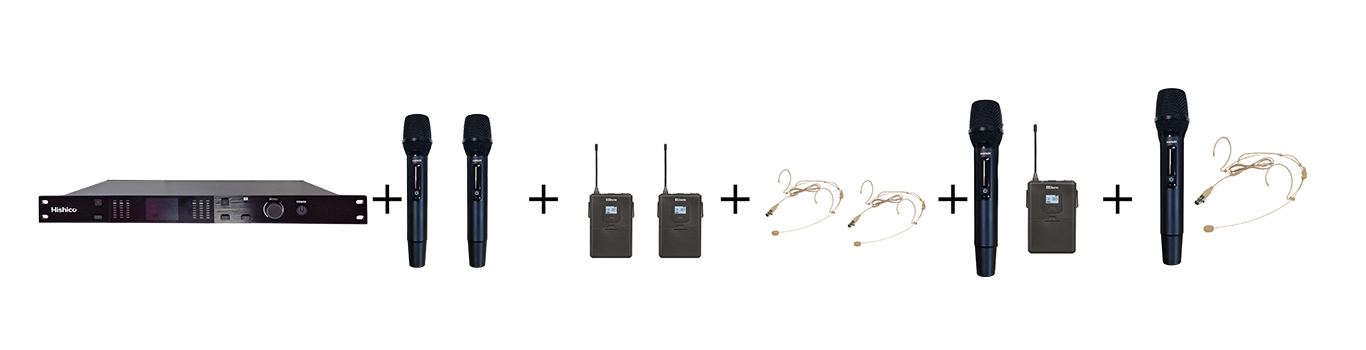
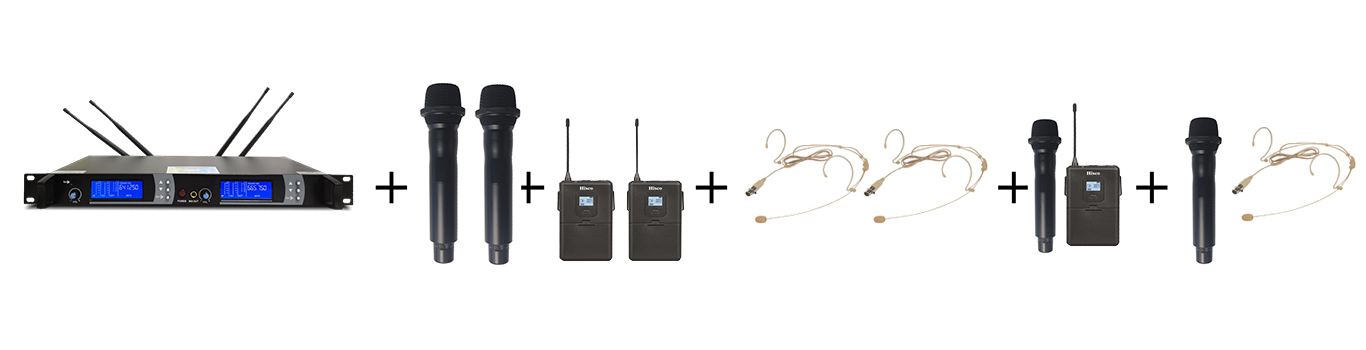
1. Operates in the UHF 560–680 MHz band
2. Features a digital solution and a true diversity four-antenna design
3. Includes 10 EQ presets, 9 reverb effects, and 9 feedback suppression modes; suppression frequencies are 1 Hz, 2 Hz, 3 Hz, 4 Hz, 5 Hz, 6 Hz, 7 Hz, 8 Hz, and 9 Hz
4. Built-in spectrum analyzer function for real-time monitoring of frequency band resources, displaying frequency usage via an intuitive graphical interface
5. True diversity microphone (one transmitter, two receivers); short transmission range—100 meters in open areas, single receiver
6. Typically used in medium- to large-sized lecture halls, conference rooms, performance venues, and similar settings
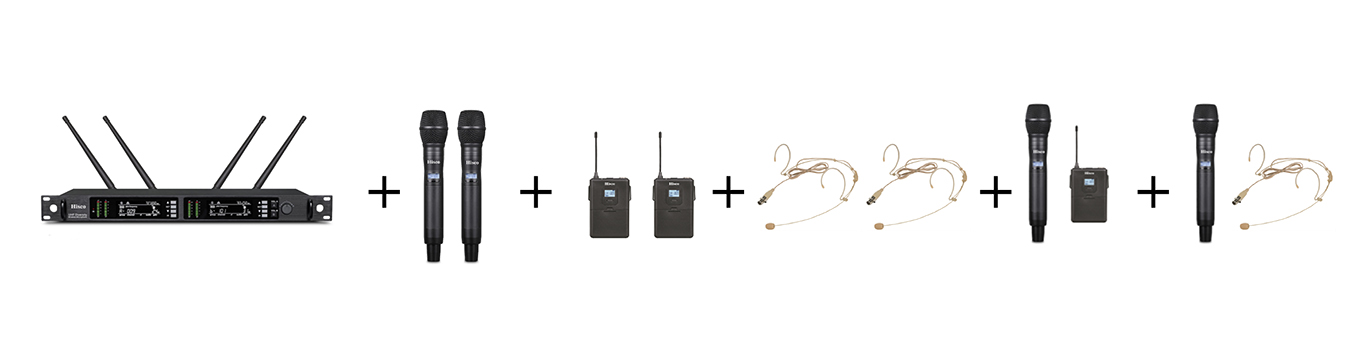
1. Utilizes UHF (Ultra-High Frequency) dual true diversity reception, providing 200 channels.
2. Frequency range: UHF 560–930 MHz, avoiding interference frequencies for convenient use.
3. Ultra-long reception range, up to 300 meters in open areas.
4. Frequency range: UHF 540–930 MHz
5. True diversity microphone (one transmitter, two receivers); short transmission distance—up to 300 meters in open areas—with a single receiver
6. Typically used in venues such as cultural performances and entertainment events