Digital Conference System Solution
I. Industry Background
• With the substantial growth in China’s national strength and the rapid advancement of modern information processing technology, enterprises, institutions, other organizations have increasingly strong demands for office modernization. Meeting rooms have therefore evolved from simple communication venues focused on listening and speaking into multi-functional hubs for the exchange of information. A wide range of electronic equipment, including slide projectors, video projectors, video recording and playback devices, and sound reinforcement systems, has been widely deployed in meeting spaces. This trend has driven conference systems to adopt more professional configurations and more powerful functionalities. As a result, today’s conference systems are generally referred to as multimedia conference systems, and the design philosophy for such systems has undergone tremendous transformations.
II. Demand Analysis
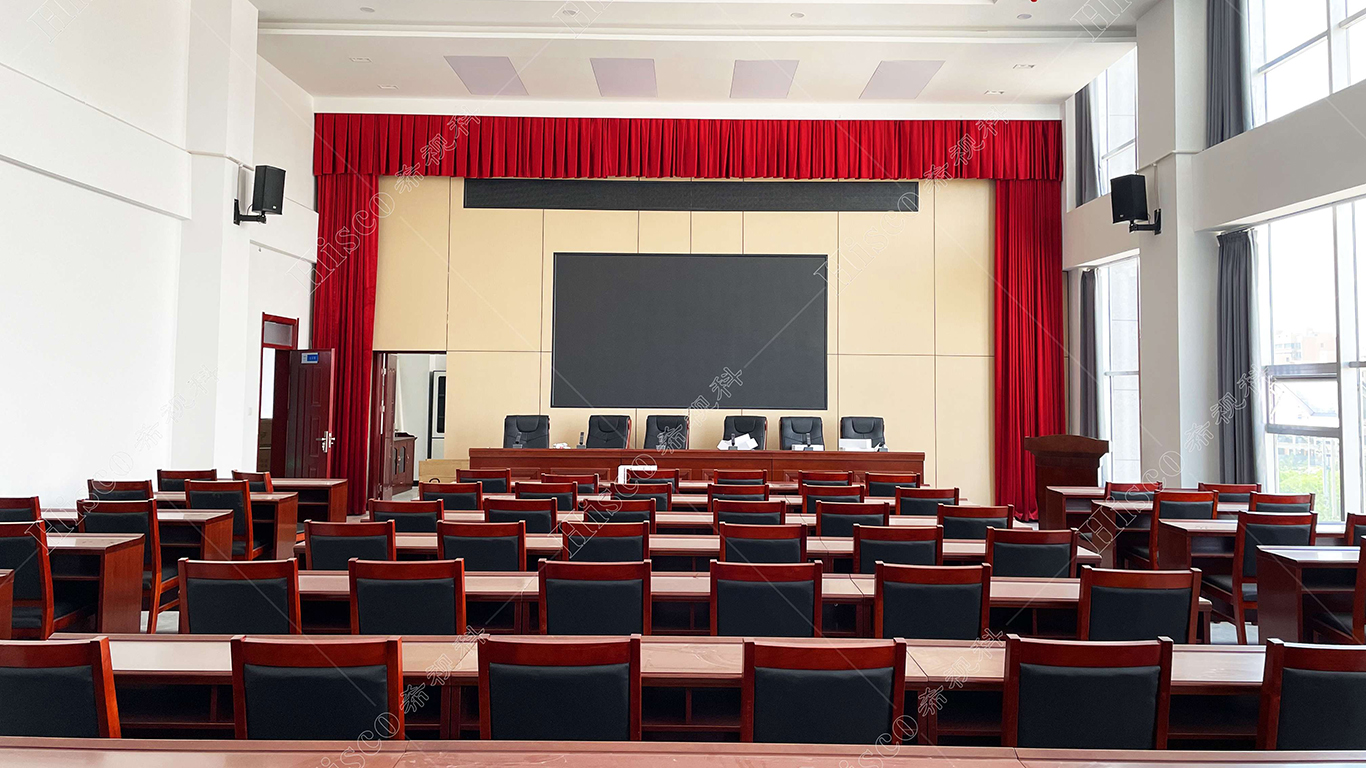
• In accordance with the development philosophy of "demand-driven, forward-looking, feasible implementation and sustainable development", the meeting room construction project aims to build an integrated venue that supports daily meetings, video conferences,and multi-functional events. The design shall feature advanced concepts, stable systems, comprehensive functions, and efficient command & control.
1. The system shall enable convenient and rapid management of all video and audio subsystems.
2. Support free switching of all signal sources in the meeting room for playback on any high-definition display device.
3. The audio sound reinforcement system shall be user-friendly and flexible to meet diverse meeting scenarios.
4. A centralized control system shall be deployed to facilitate quick and easy overall system management.
5. Equip with voting and election functions.
6. Meet the requirements for conference discussion, voting and balloting.
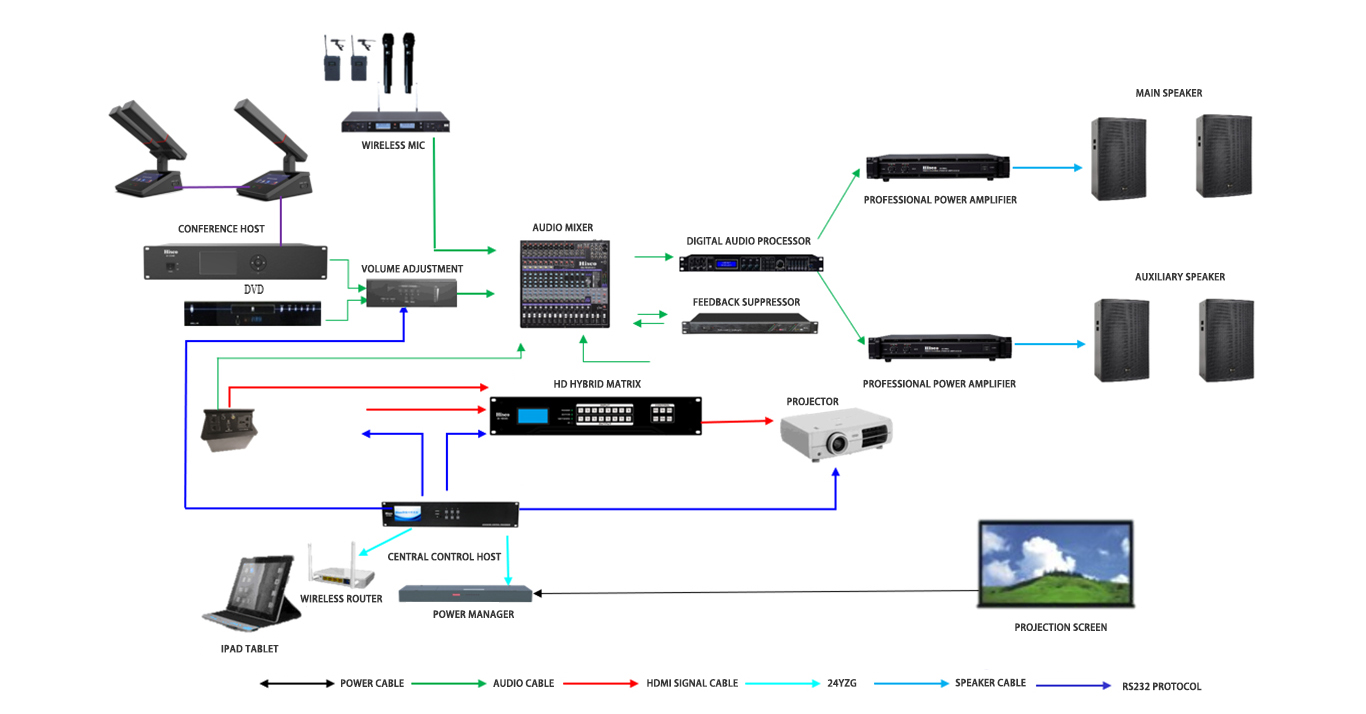
III. System Topology Diagram
IV. Design Scheme
• We propose an optimal solution to build an integrated meeting room supporting daily meetings and video conferences, ensuring the system boasts the following advantages:
1. Deliver high speech intelligibility across the entire venue and maintain sufficient sound pressure level for extended periods. When operating normally, all parameters of the sound reinforcement system shall meet Class I standards for combined speech and music applications specified in national industrial specifications.
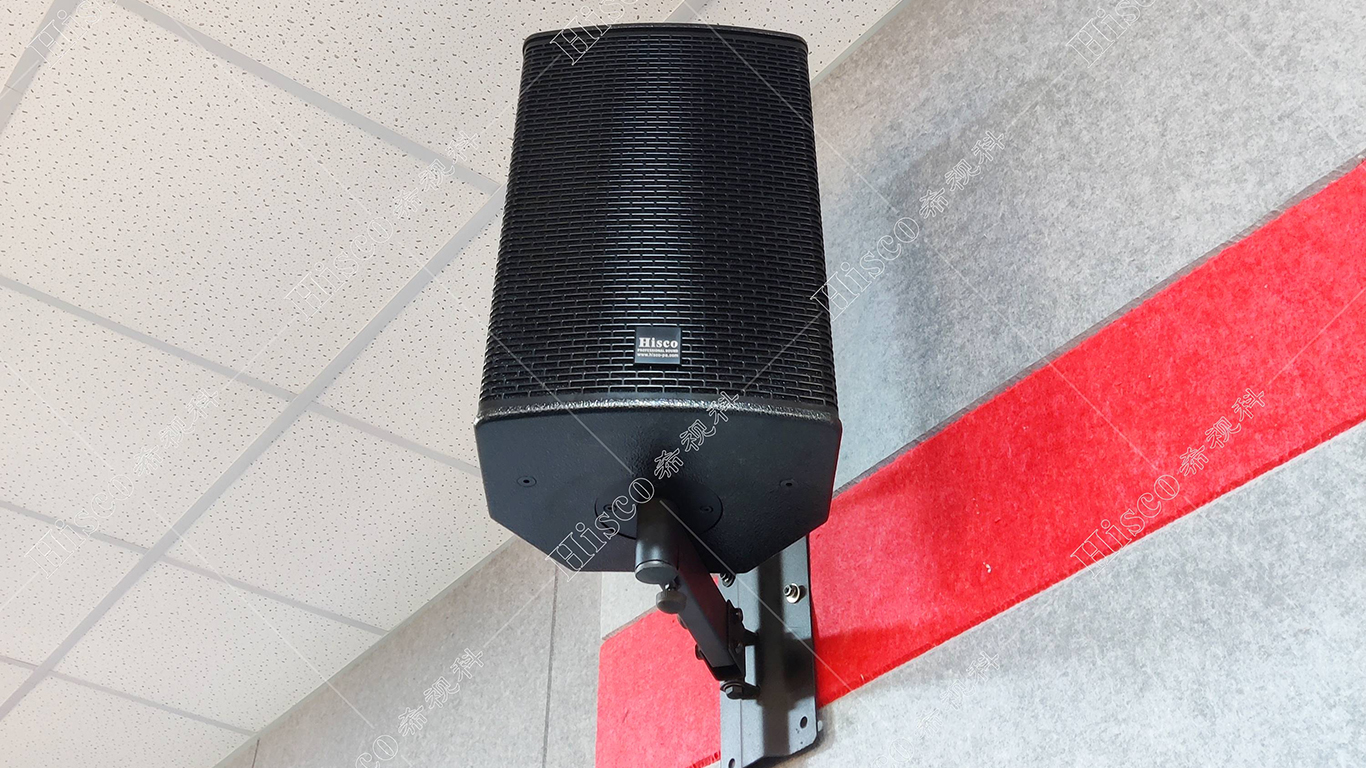
2. Loudspeakers shall achieve even sound and frequency response coverage throughout the service area. The appearance and mounting positions of speakers shall not compromise the venue’s overall interior style.
3. No obvious acoustic defects such as echo, flutter echo, or sound focusing shall occur at any seat in the venue. (Note: If necessary, sound absorption treatments are not implemented during venue decoration, auxiliary manual measures shall be adopted during meetings for acoustic compensation, such as drawing thick fabric curtains completely.)
4. Multiple system protection mechanisms shall be designed to guarantee long-term stable and reliable operation of the audio system, and swiftly safeguard speakers and audio equipment from damage in case of emergencies.
5. Speakers adopt constant-impedance one-to-one transmission with impedance matching between speakers and power amplifiers. Full-range wide-frequency speakers are deployed to reproduce premium sound quality. The audio reinforcement system features user-friendly operation and flexible functions to satisfy diverse meeting requirements.
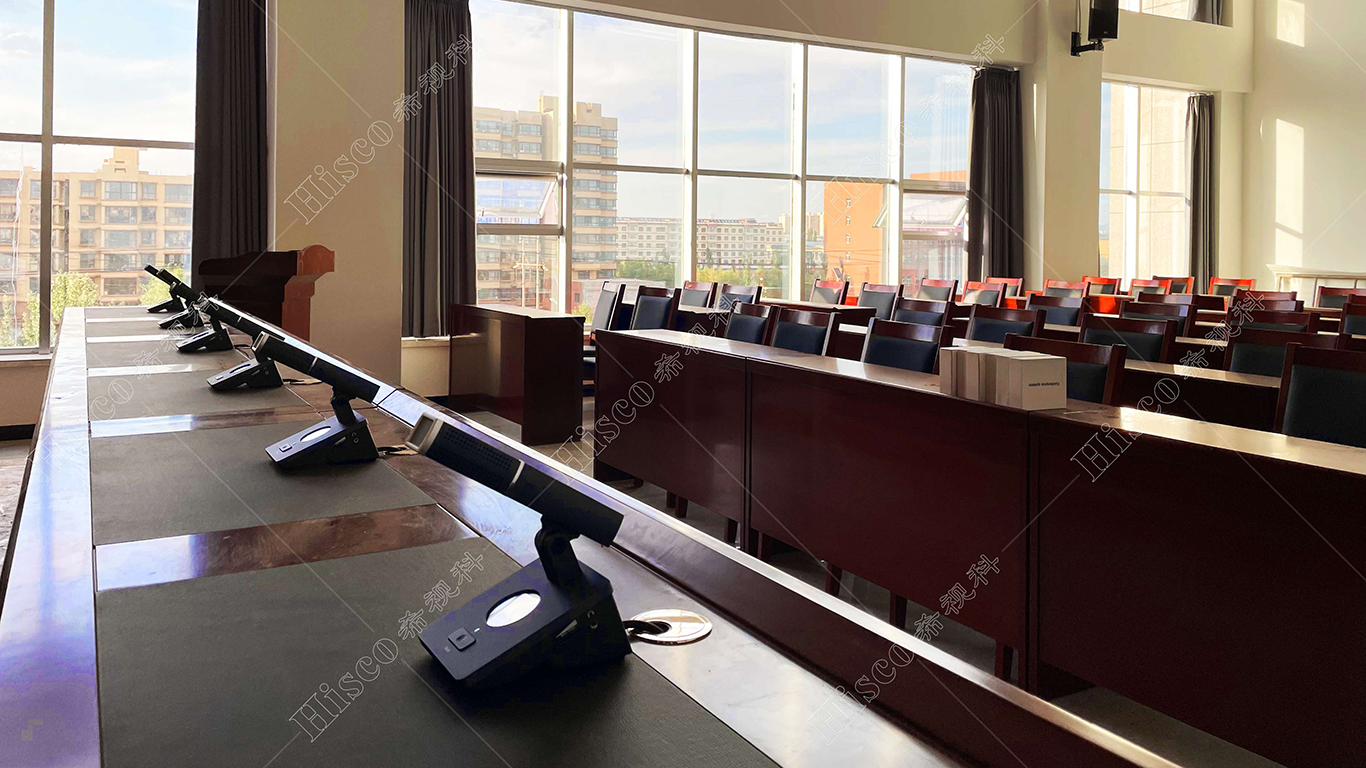
6. The digital conference system adopts daisy-chain wiring. Discussion units are portable and daisy-chain mountable with an elegant appearance and flexible installation. It requires minimal cabling without disrupting the overall decoration layout, delivers outstanding sound quality, and features a pickup distance of 50–80 centimeters.
7. The main unit of the conference discussion system supports multiple working modes for convenient operation: First-In First-Out Mode, Normal Mode, Restricted Mode, Free Talk Mode, Request Mode, and Voice-Activated Mode.
8. The central control host can be programmed to remotely control PTZ rotation, lens zoom, and focus of surveillance cameras, and link with the conference main unit to enable camera tracking for close-up framing of speaking participants.
9. Audio and video input signals of the meeting room include camera signals, DVD audio & video signals, laptop/PC audio & video signals, etc. Output signals cover the projector and TV signals. All audio and video signals are switched and routed via a video matrix.
10. The meeting room shall be equipped with a hybrid HD matrix with optional signal interface cards supporting VIDEO, S-Video, VGA, YPbPr, DVI, HDMI, SDI, Fiber, and twisted pair (HDBaseT) signals.
11. Paired with transmitters, the hybrid HD matrix supports bidirectional transmission of IR and RS-232 control signals. The matrix can be controlled via three methods: RS-232, Ethernet, and physical buttons.
12. The central control system realizes matrix switching, camera control, projector control, projection screen lifting/lowering, power management, volume adjustment, DVD player control, motorized curtain control, and air conditioner control. It enables convenient and rapid management of all audio and video subsystems within the meeting room as an integrated whole.
13. The central control host fully supports remote network control with a built-in Ethernet port and network cascading capability. It is compatible with iPad/iPhone handheld terminals to communicate with the host via Wi-Fi.