Broadcast System Solution for Shelter Hospital
I. Industry Background
• Against the backdrop of China’s new medical reform and emergent public health incidents, an audio and video solution for Xiaotangshan-style hospitals shall be developed, supported by Internet of Things technologies and data resources. The construction shall adhere to the principles of prioritizing prevention, focusing on daily preparedness, integrating prevention and treatment, enabling rapid response, implementing tiered accountability, and relying on scientific approaches.
• The solution facilitates the publicity and popularization of knowledge on major infectious disease prevention and control, establishes a prevention and control network, and implements a long-term mechanism to comprehensively upgrade hospital health care services.
• Shelter hospitals follow the goals of "timely detection, rapid disposal, precise control and effective treatment". They refine management systems and standardize workflows, establishing standardized regulations and procedures covering diagnosis and treatment in isolation units, admission registration, medical observation, emergency medical treatment, expert consultations, patient transfer, rescue for common critical illnesses, information management, and discharge after isolation release. These systems provide solid institutional guarantees for the safe, orderly, and efficient operation of shelter hospitals, and lay a sound foundation for patient health monitoring and medical service delivery.
II. Demand Analysis
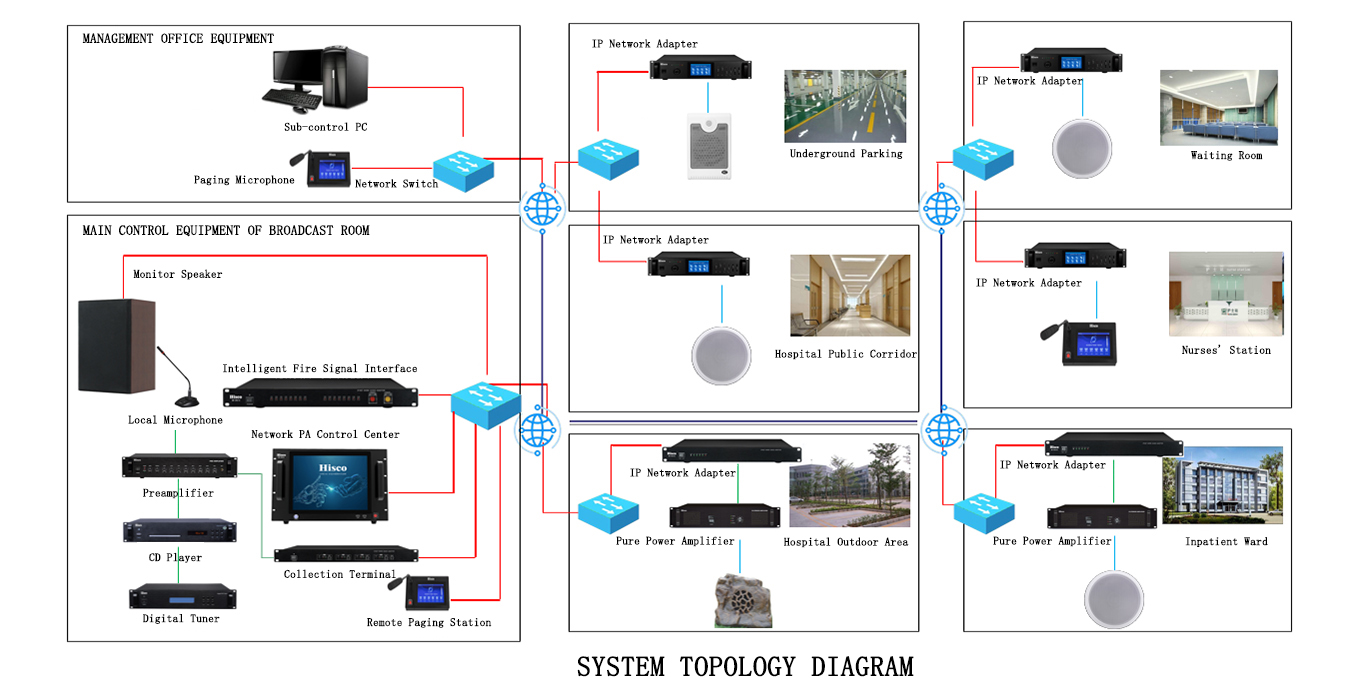
• A shelter hospital generally consists of medical functional units, ward units, technical support units, and other components. As a modular medical facility, it integrates multiple capabilities including emergency treatment, surgical intervention, and clinical testing. The public address system deployed in shelter hospitals shall not only support routine service broadcasting and emergency broadcasting, but also enable fire alarm linkage with the hospital, sub-control management at nurse stations, medical information dissemination, health and rehabilitation education, emergency call-for-help functions, two-way intercom communication, and patient queue notification functions.
III. System Topology Diagram
IV. Implementation Effects
1. Emergency Broadcasting
In the event of an emergency, emergency broadcast messages can be broadcast immediately. All other functions of the public address system (background music, regular broadcasting, etc.) will be suspended immediately to facilitate the rapid evacuation of personnel and guide evacuation routes until the emergency broadcast mode is deactivated.
2. Information Dissemination
The hospital can utilize the PA system to facilitate the rapid evacuation of personnel broadcast information such as the hospital profile, organizational structure, on-duty physicians and other information in patient admission areas. Service desks can operate remote paging microphones to release broadcast announcements, broadcast information and conduct paging intercom.
3. Nurse Station Communication
Staff can issue broadcast notifications for designated zones via network microphones at nurse stations, and two-way communication is available between staff members.
4. Emergency Assistance
The system supports one-touch emergency intercom. When medical staff or patients encounter emergencies, they can send an emergency assistance request to the hospital duty room through emergency call terminals.
5. Sub-control Management
Managers and supervisors do not need to go to the equipment room. They can log into the PA system management platform remotely from their offices to control background music playback, release notifications and conduct system management.
6. Background Music
Background music broadcasting can be used to broadcast health education programs and medical information in outdoor public areas of the hospital, and play relaxing background audio in patient rehabilitation areas to create a comfortable healing environment.