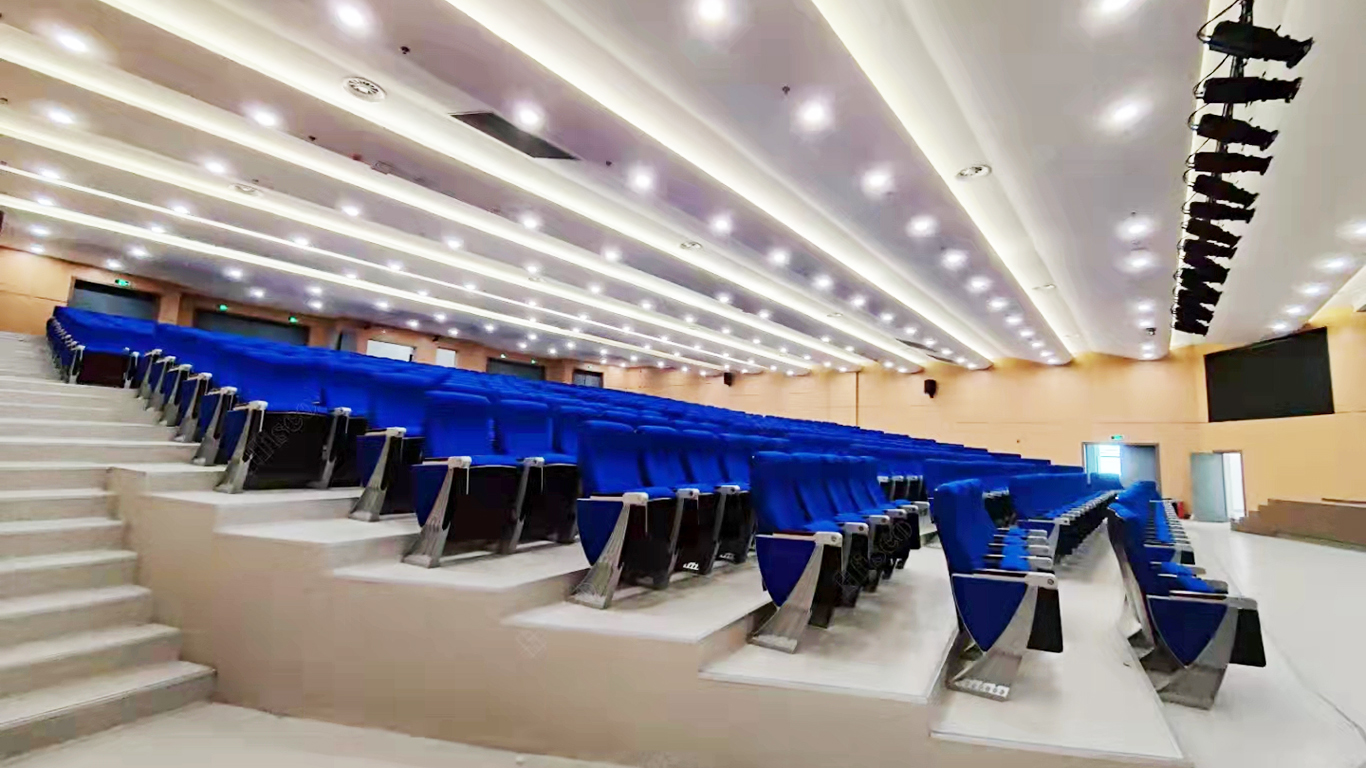
Report Hall Auditorium Solution
I. Industry Background
Benefiting from China’s growing economic strength and the rapid advancement of modern information technology, enterprises and institutions are continuously upgrading the standards for digital workplaces. Traditional meeting rooms have evolved from simple spaces for listening to presentations into multi-functional comprehensive hubs for information exchange. With widespread installation of projectors, video recording devices, and professional audio equipment, contemporary conference facilities have been transformed into standardized multimedia conference systems featuring enhanced functionalities and optimized design specifications.
II. Requirement Analysis
Guided by the principles of being demand-oriented, forward-looking, practical, and sustainable, this integrated system supports daily meetings, video conferences, and multi-purpose events. It features advanced design, stable performance, comprehensive functionalities, and efficient centralized control. Specifically, the system must:
1. Enable convenient unified management across all audio and video subsystems;
2. Adopt high-lumen DLP engineering projectors or LCD displays to ensure high contrast, sharp imagery, uniform brightness, vivid colors, and long-term display stability;
3. Deploy a flexible sound reinforcement (PA) system adaptable to diverse conference scenarios;
4. Implement a centralized control platform for rapid, whole-system operation;
5. Fulfill the requirements for regular in-person meetings, remote video conferences, and multi-functional activities;
6. Support HD signal transmission, seamless terminal access, and high-definition display output;
7. Ensure high-quality voice capture and clear audio reproduction for conference discussions and speeches.
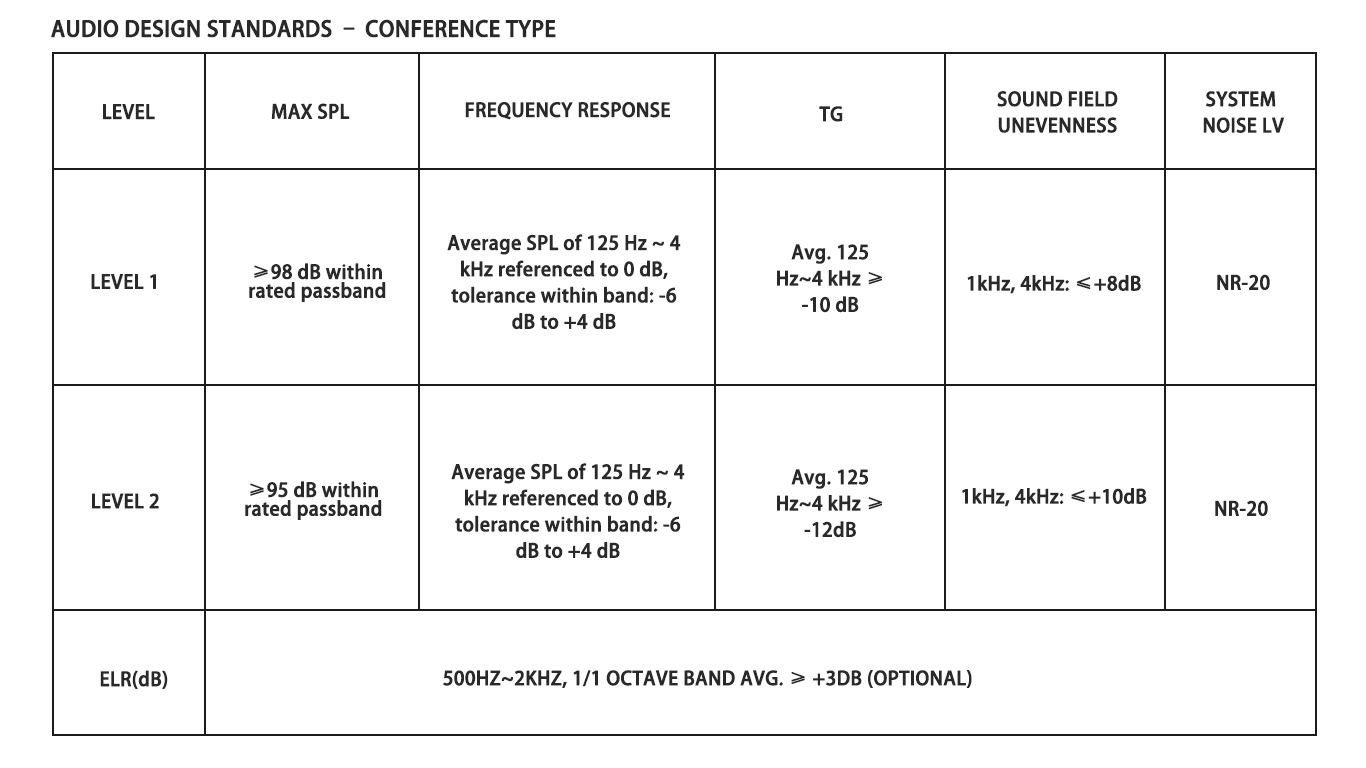
III. Design Standards
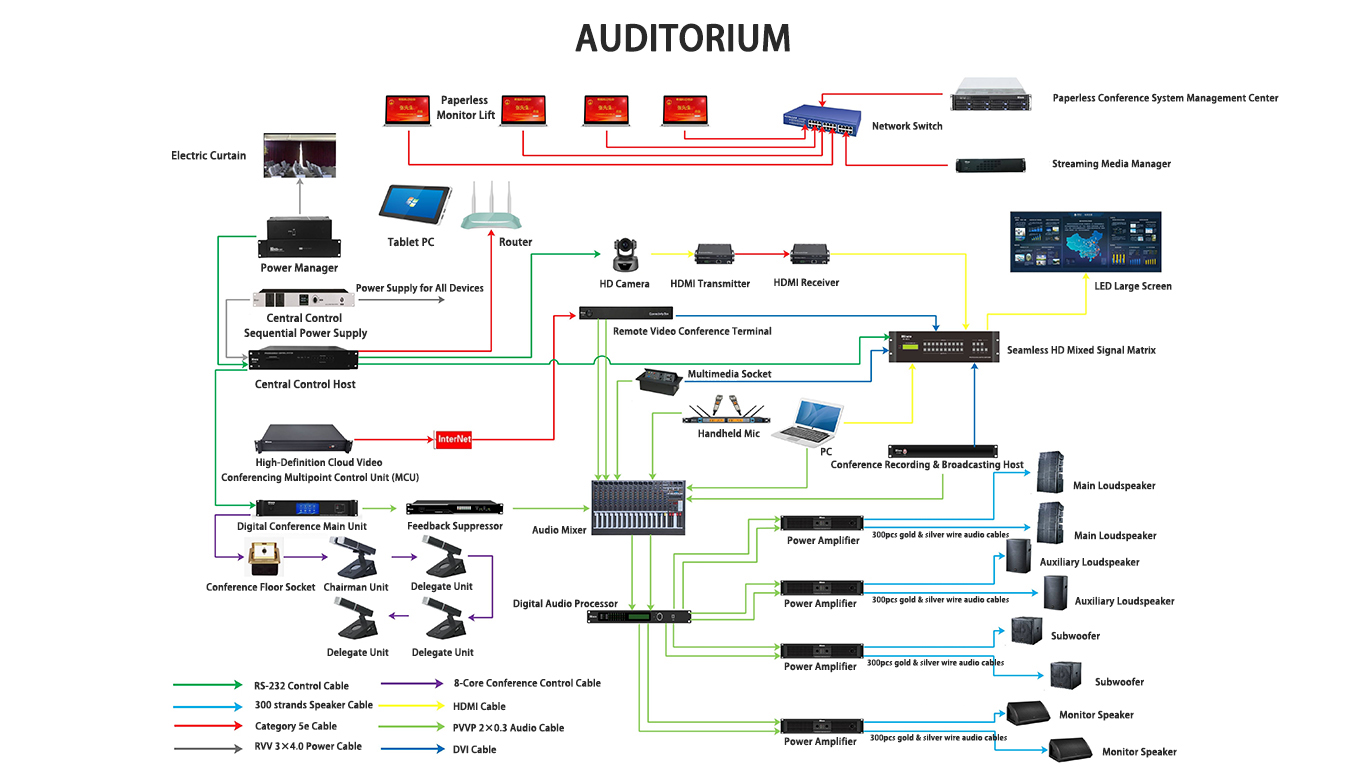
IV. System Topology Diagram
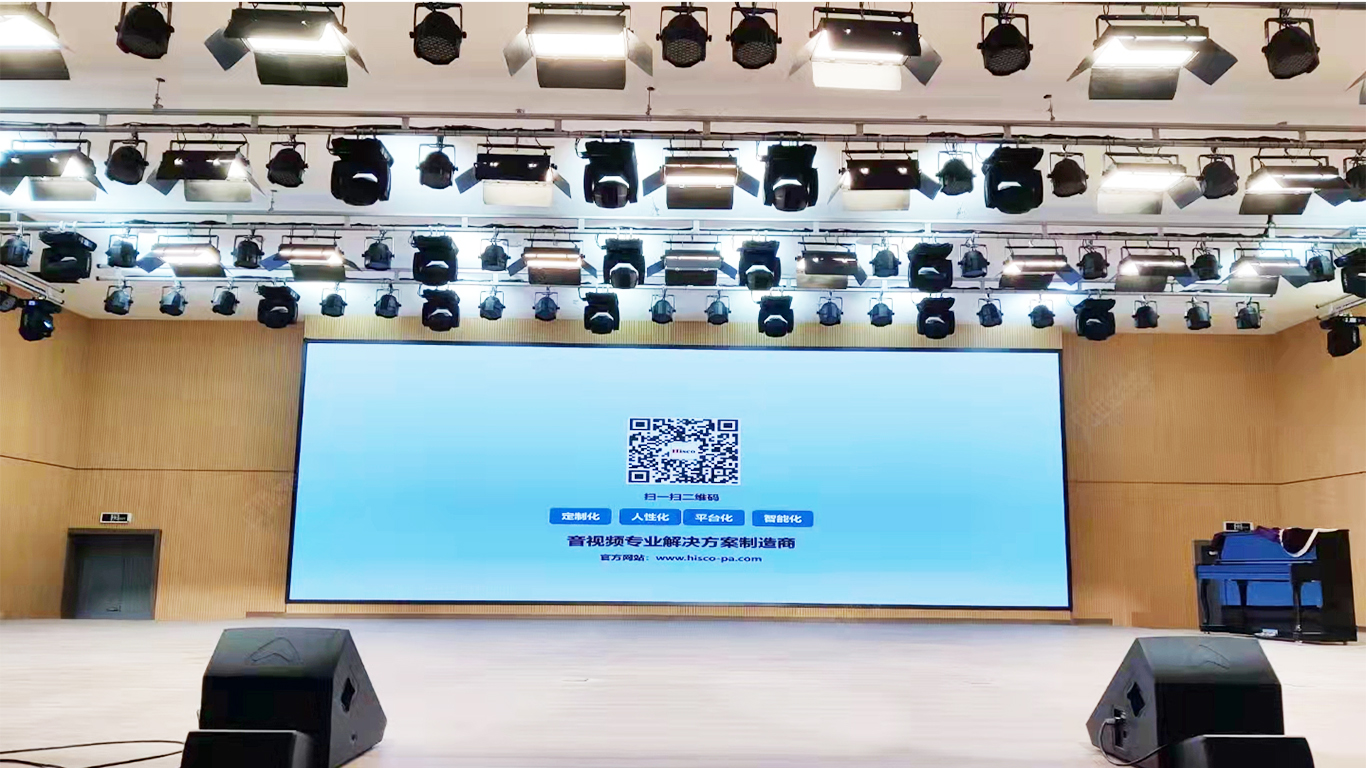
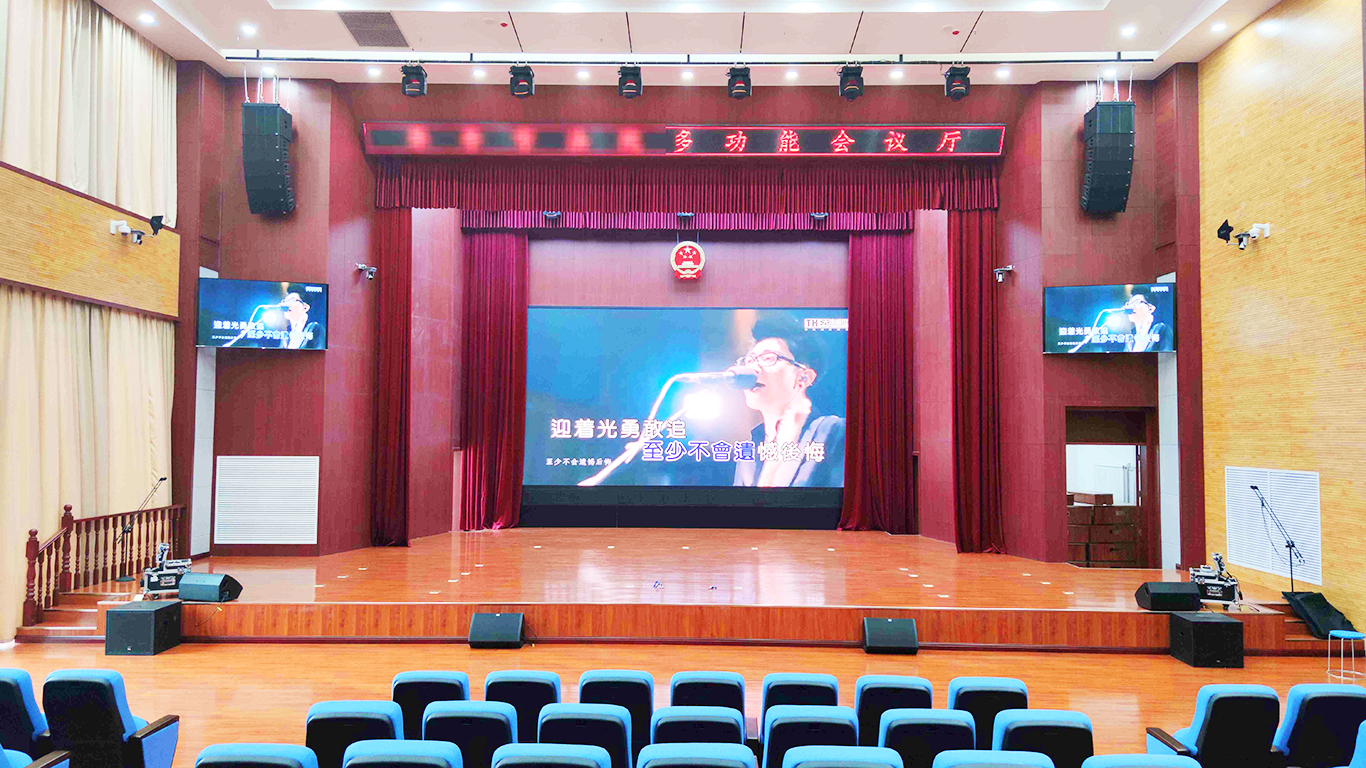
V. Project Implementation Effect
1. Adequate sound pressure level
With upgraded recording technology and rising public expectations for audio quality, professional sound systems must reserve sufficient dynamic headroom to ensure distortion-free reproduction of audio signals with wide dynamic ranges. High-power, high-sensitivity loudspeakers are carefully matched with amplifiers that have sufficient power headroom, ensuring the finished venue fully complies with the National Class 1 Standard for Acoustic Design of Auditoriums.
2. Excellent sound field uniformity
Speakers are configured as point-source arrays, tailored to the audience seating layout to reduce comb filtering effects. Furthermore, constant-directivity loudspeakers improve speech intelligibility and ensure full coverage of the entire audience, with uniform sound distribution verified through acoustic modeling.
3. Smooth frequency response characteristics
Each speaker channel is calibrated via parametric equalizers (PEQ) to maintain a consistent beam width across the full frequency range, ensuring a smooth frequency response free of unexpected peaks or dips. In addition, digital room equalizers (DRE) are used to optimize the acoustic coupling between the main auditorium and the screen area, guaranteeing a flat overall system frequency response.
4. Reliable acoustic feedback gain
The optimized speaker layout ensures full coverage of the audience area. By adopting constant-directivity horns with sharp acoustic roll-off outside the -6dB coverage angle, the system can reliably achieve the designed transmission gain target.
5. Strong compatibility and expandability
In addition to meeting the requirements of conference speech reinforcement, this system also supports high-fidelity music playback, with an effective frequency response range of 35Hz to 18kHz. All equipment reserves spare interfaces to accommodate future function expansion.